Here's the critique in a nutshell: Japan in the early 1990s, like the U.S. today, saw a real-estate bubble burst, spawning a banking and credit crisis that drove the whole economy down, hard. The Japanese then tried stimulating the economy with giant doses of government spending, which didn't pep things up -- but did bring on deficits that required tax increases later, dragging out Japan's problems for years. ... Rep. Ryan argues that the Japanese, arriving at the crossroads the U.S. sees today, "went into heavy deficit spending on infrastructure and they continued to languish....They cranked up their debt through Keynesian spending, and it didn't work." His fear is that the U.S., by spending heavily on stimulus now, will, like the Japanese, make economically chilling tax increases inevitable down the line to balance the books. "I worry we could be inviting a lost decade in America with wrong-headed fiscal policy," he says. A new study by Republicans on the House Budget Committee, where Rep. Ryan is the top GOP member, argues that Japan's policy mistakes led to "a protracted period of stagnation."Japan's big spending "stimulus" was too slow to stimulate and having to pay for it lengthened the torpor. The slow speed war partly the kind of projects they tried. Big construction has a long lead time, so its fiscal stimulus comes 2 to 5 years later. The parallel is not perfect. Japan raised taxes. That's not likely to happen. Although the Democrats always have a reason to raise taxes. And Japan had a tight money policy; we are doing the opposite. And we have to make sure we avoid the "bow wave" effect that we see in Washington every biennium. The Legislature has some extra money, so they start a new program in the second of the two years and it doesn't cost that much for the first year. But it is permanent and inevitably grows. So the "cheap" new program soon becomes a drag. Japan was successful on this. We need to be careful. So we have to stop the pork projects and get the speedy ones. Tax cuts are fast! Broad tax cuts will have a huge effect. Let's be careful and fast!
Tuesday, February 03, 2009
Avoiding a lost decade like Japan
We can see what to avoid as we try to stimulate our economy. Well, we want to, but Nancy Pelosi just wants to pay off her big Democratic supporters with pork and more pork. But in trying to stimulate it is too easy to get it wrong. Japan did in a big way. It was so bad that the 1990s is called Japan's "lost decade."
Gerald Seib - Avoiding Japan's Stimulus Miscues - WSJ.com:


A (cheap) pen for us lefties
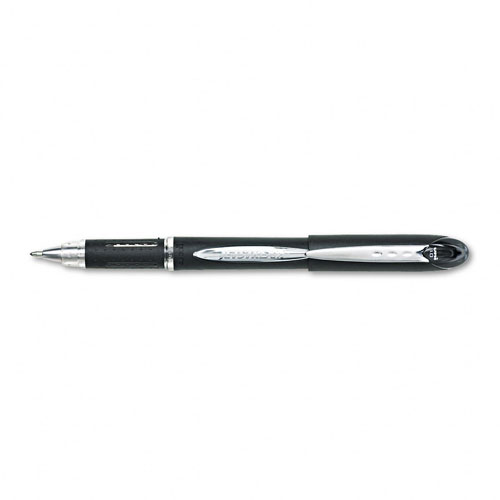 Being left handed I have fought smearing of my writing since age 5, whether pencil or pen. Indeed, I seldom use pencil because it always smears. But a pen with quick-drying, permanent ink fills the bill. First, it dries quickly enough, because the main problem is smearing what you wrote seconds ago. Second, it stays dry.
My third requirement is price. I have enough frights with misplacing my cell phone and iPod. I don't want to be frantically searching for my $40 pen. So they must cost less than $3 apiece.
I have been on this quest for over 20 years. During the 1980s one of the big Japanese manufacturers had a line of pigment pens that filled the bill. But they disappeared without a replacement. At least not a cheap enough one.
Uni-Ball has come through. I discovered the Uni-Ball Jetstream about a year ago. Here is the Jetstream Stick Roller ball pen, which sells for $2.39 online and a similar price at RiteAid stores here. It also comes in a click version.
Being left handed I have fought smearing of my writing since age 5, whether pencil or pen. Indeed, I seldom use pencil because it always smears. But a pen with quick-drying, permanent ink fills the bill. First, it dries quickly enough, because the main problem is smearing what you wrote seconds ago. Second, it stays dry.
My third requirement is price. I have enough frights with misplacing my cell phone and iPod. I don't want to be frantically searching for my $40 pen. So they must cost less than $3 apiece.
I have been on this quest for over 20 years. During the 1980s one of the big Japanese manufacturers had a line of pigment pens that filled the bill. But they disappeared without a replacement. At least not a cheap enough one.
Uni-Ball has come through. I discovered the Uni-Ball Jetstream about a year ago. Here is the Jetstream Stick Roller ball pen, which sells for $2.39 online and a similar price at RiteAid stores here. It also comes in a click version.
Monday, February 02, 2009
Taxes for you, but not for Obama's Health Czar Tom Daschle
Former Senator Tom Daschle forgot to pay income tax on $225,000 in services received in the form of a personal car and driver. Obama's chosen health-care czar is above paying taxes.
Taxes for you, but not for him. In the Congress and Senate he always voted for tax increases and against tax cuts. And he was hard on tax cheats. CNS News.
“Make no mistake, tax cheaters cheat us all, and the IRS should enforce our laws to the letter,” Daschle said in 1998, according to the Congressional Record.But for him it's different. Driving Tom Daschle - WSJ.com:
As a legal tax matter, this isn't even a close call. Mr. Daschle says he used the car service about 80% for personal use, and 20% for business. But his spokeswoman says it only dawned on the Senator last June that this might be taxable income. Mr. Daschle's excuse? According to a Journal report Friday, "he told committee staff he had grown used to having a car and driver as majority leader and did not think to report the perk on his taxes, according to staff members." How's that for a Leona Helmsley moment: Doesn't everyone have a car and chauffeur, dear?New Treasury Secetary Geithner didn't forget to pay. Every year he applied to his employer the IMF for pay to offset the Social Security taxes he had to pay. Each year he signed that he knew it was up to him to pay. He didn't forget. He cheated. And when audited he paid for the years audited - 2003 and 04, I think - but he didn't go back to pay 2001, etc. Because, again, he hadn't forgotten. He was cheating.
The Mac - 25 years of leadership
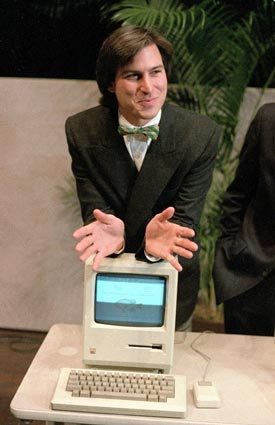 The Mac was introduced at the Super Bowl in 1984. I was a fan from the first day, since I am a very graphic person. I had one on my desk at work in 1986 and bought an SE-30 for home use in 1989 and have owned one or more ever since.
Seattle Times Newspaper:
The Mac was introduced at the Super Bowl in 1984. I was a fan from the first day, since I am a very graphic person. I had one on my desk at work in 1986 and bought an SE-30 for home use in 1989 and have owned one or more ever since.
Seattle Times Newspaper:
The Apple Macintosh, born at the hands of renegade engineers in the early 1980s, changed the relationship between human and keyboard. The Mac, which turned 25 last week, has consistently been an industry pioneer of new technology, including the graphical user interface, speech, Wi-Fi and video. "Apple redefined the computer beyond crunching ones and zeros. It made a technology lifestyle a reality," said Jupiter Research analyst Michael Gartenberg. More than two decades after Mac engineers toiled away in buildings flying pirate flags under the direction of Apple co-founder Steve Jobs, the Macintosh now sits at the center of Apple's digital universe. The company's ability to match hardware with software, such as its popular iLife photo and video programs, is unparalleled in the industry.
Sunday, February 01, 2009
We show tolerance to 'gays' and get tyranny in return
The "gays" have made even very liberal Peter Hitchens turn against them. They started by asking for tolerance, then demanding it. Now they insist on acceptance. Full acceptance, no negative words.
PETER HITCHENS - Daily Mail - UK
If I never again had to read or write a word about homosexuals, I would be very happy. I really don't want to know what other people do in their bedrooms. But these days they really, really want us all to know. And, more important, they insist that we approve. No longer are we allowed to keep our thoughts to ourselves, while being polite and kind.
We are forced to say that we think homosexuality is a good thing, that homosexual couples are equal in all ways to heterosexual married couples. Most emphatically, we are compelled to agree that homosexual couples are just as good at bringing up children as the children's own grandparents. Better, in fact.
Many people who believe nothing of the kind now know that their careers in politics, the media, the Armed Services, the police or schools will be ruined if they ever let their true opinions show. I am sure that many of them regularly lie about their views, to avoid such trouble.
We cringe to the new Thought Police, like the subjects of some insane, sex-obsessed Stalinist state, compelled to wave our little rainbow flags as the 'Gay Pride' parade passes by.
And that's another thing. We can't even call homosexuals 'homosexuals' any more. This neutral word is not considered enthusiastic enough. We have to say 'gay'. Which is exactly why I don't, apart from in inverted commas.
You think I exaggerate the power and fury of these forces? The totalitarian rage on this subject is quite astonishing. I have had several brushes with it, and been called rude names by its militants.
Well, I can live with that. It's my job. But what about a powerless pair of grandparents in Edinburgh, their grandchildren's lives shipwrecked by the multiple horrors of our 'liberated' society?
First, their daughter ends up as a drug abuser, like so many others in a country which permits the endless promotion of drug use by rock stars and refuses to punish the possession of narcotics, the only measure that would work.
Then, when they seek to look after her children, they are first insultingly informed that they are too old, and that their minor illnesses disqualify them from the task. Heaven help any employer who dared 'discriminate' in this fashion. But the new Thought Police are oddly exempt from their own rules.
Next, the grandparents are informed that the children are to be put into the care of a homosexual couple. And - this is the crucial moment - they are warned in the most terrifying terms that if they object to this arrangement they will never see their grandchildren again.
Leave aside the rest of it. It is this demand, that they mouth approval of the new regime like the defendants at some show trial, which is the bit that ought to make your flesh creep.
This is the action of a tyranny in operation, especially the use of children to blackmail their parents and grandparents. People who can do this can do anything.
Isn't it amazing to reflect that this campaign began in the name of tolerance?
Friday, January 30, 2009
Four years for Bush's 'Google Bomb,' Google Quickly Defuses Obama's
It's just a coincidence. Nothing to do with the fact that CEO Eric Schmidt hit the road to campaign for Obama.
FOXNews.com
It took four years for Google to address the "Google bomb" that was lobbed at former President Bush.
But it took the Internet behemoth only a few days to defuse the same attack on President Obama.
Four years versus a few days ... Some Googlers are asking why.
Wednesday, January 28, 2009
Economists who do not support massive debt for pork aka Stimulus
There are many economists who disagree with the stampede for a massive "stimulus." Massive debt to pay for massive pork didn't work in 1929 - it caused the US to have a far worse depression than Europe - and won't work now.
 Cato instutute - Fiscal Reality Central:
 Cato instutute - Fiscal Reality Central:
Notwithstanding reports that all economists are now Keynesians and that we all support a big increase in the burden of government, we do not believe that more government spending is a way to improve economic performance.
More government spending by Hoover and Roosevelt did not pull the United States economy out of the Great Depression in the 1930s. More government spending did not solve Japan's "lost decade" in the 1990s.
As such, it is a triumph of hope over experience to believe that more government spending will help the U.S. today. To improve the economy, policy makers should focus on reforms that remove impediments to work, saving, investment and production.
Lower tax rates and a reduction in the burden of government are the best ways of using fiscal policy to boost growth.
Tuesday, January 27, 2009
Stimulus won't work - top Obama economist
Larry Summers says Nancy Pelosi' proposal would be worse than the disease.
Summers v. Summers - Andy McCarthy - The Corner on National Review Online:
Who says a stimulus plan of the type contemplated by the Obama Dems won't work? Why, the head of Obama's Council of Economic Advisers, that's who.
At Heritage, Conn Carroll points out that, not so long ago, Larry Summers had this to say about stimulus plans:
Poorly provided fiscal stimulus can have worse side effects than the disease that is to be cured....
[F]iscal stimulus, to be maximally effective, must be clearly and credibly temporary – with no significant adverse impact on the deficit for more than a year or so after implementation. Otherwise it risks being counterproductive by raising the spectre of enlarged future deficits pushing up longer-term interest rates and undermining confidence and longer-term growth prospects.
As Carroll elsewhere points out (citing, for example, the Medicaid bailout, Medicaid expansion, family planning loophole, education bailout, and education shopping spree), the Democrats' proposed package is anything but temporary . . . and a Thomas Barthold, Deputy Chief of the Joint Committee on Taxation's staff has conceded (notwithstanding rosy predictions by President Obama and Speaker Pelosi) that the Committee has no estimates indicating any meaningful amount of jobs or economic growth would actually result.
Monday, January 26, 2009
Nancy Pelosi claims that $100 million for contraception will 'stimulate' the economy
The left has one priority that always stays on top. Abortion - call it something else, but it's still abortion.
Will her proposed funding do what she claims? Prove it. But it does end a lot of lives. Priorities.
American Thinker Blog
STEPHANOPOULOS: Hundreds of millions of dollars to expand family planning services. How is that stimulus?
PELOSI: Well, the family planning services reduce cost. They reduce cost. The states are in terrible fiscal budget crises now and part of what we do for children's health, education and some of those elements are to help the states meet their financial needs. One of those - one of the initiatives you mentioned, the contraception, will reduce costs to the states and to the federal government.
STEPHANOPOULOS: So no apologies for that?
PELOSI: No apologies. No. we have to deal with the consequences of the downturn in our economy.
Friday, January 23, 2009
Midlife coffee may help stave off dementia
 Drinking coffee is good for you. Study after study finds good effects. And some find bad effects. But the balance is not negative. So, drink up.
UPI.com:
Midlife coffee drinking may decrease the risk of dementia and Alzheimer's disease later in life, researchers in Sweden and Finland said. The study was conducted at the University of Kuopio in Finland in collaboration with Karolinska Institutet in Stockholm, Sweden, and the National Public Health Institute in Helsinki, Finland.
Participants were the survivors of two population-based studies. After an average follow-up of 21 years, 1,409 individuals ages 65 to 79 completed the re-examination in 1998. Sixty-one cases were identified as having dementia and 48 with Alzheimer's disease.
Lead researcher Miia Kivipelto of the University of Kuopio and Karolinska Institutet said at the midlife examination, the consumption of coffee and tea was assessed with a semi-quantitative food-frequency questionnaire. Coffee drinking was categorized into three groups: zero to two cups cups, three to five cups and more than five cups per day. Tea consumption was characterized as zero cups a day, or more than one cup a day.
The study, published in the the Journal of Alzheimer's Disease, found that coffee drinkers at midlife had lower risk for dementia and later in life compared to those drinking no or only little coffee.
The lowest risk -- 65 percent decrease -- was found among moderate coffee drinkers drinking three to five cups of coffee a day. Tea drinking was relatively uncommon and was not associated with dementia or Alzheimer's disease, the researchers said.
Drinking coffee is good for you. Study after study finds good effects. And some find bad effects. But the balance is not negative. So, drink up.
UPI.com:
Midlife coffee drinking may decrease the risk of dementia and Alzheimer's disease later in life, researchers in Sweden and Finland said. The study was conducted at the University of Kuopio in Finland in collaboration with Karolinska Institutet in Stockholm, Sweden, and the National Public Health Institute in Helsinki, Finland.
Participants were the survivors of two population-based studies. After an average follow-up of 21 years, 1,409 individuals ages 65 to 79 completed the re-examination in 1998. Sixty-one cases were identified as having dementia and 48 with Alzheimer's disease.
Lead researcher Miia Kivipelto of the University of Kuopio and Karolinska Institutet said at the midlife examination, the consumption of coffee and tea was assessed with a semi-quantitative food-frequency questionnaire. Coffee drinking was categorized into three groups: zero to two cups cups, three to five cups and more than five cups per day. Tea consumption was characterized as zero cups a day, or more than one cup a day.
The study, published in the the Journal of Alzheimer's Disease, found that coffee drinkers at midlife had lower risk for dementia and later in life compared to those drinking no or only little coffee.
The lowest risk -- 65 percent decrease -- was found among moderate coffee drinkers drinking three to five cups of coffee a day. Tea drinking was relatively uncommon and was not associated with dementia or Alzheimer's disease, the researchers said.
Thursday, January 22, 2009
Financial fear in the UK
The UK got more overextended than the US. Not as bad as Iceland, but frighteningly bad.
Reykjavik-on-Thames - International Herald Tribune
LONDON: An island nation that bulked up on debt and lived beyond its means. A plunging currency. And a financial system edging toward nationalization.
With the pound at a seven-year low and still falling, and the British banking system requiring ever-larger rounds of government support, it is no wonder that observers in recent days have pronounced this city "Reykjavik-on-Thames."
While that judgment seems exaggerated, there are uncomfortable echoes of Iceland's financial downfall in Britain's trajectory. And for ordinary consumers, who enjoyed a long boom that transformed the drab United Kingdom of old into Cool Britannia, fears are growing that Britain could return to the economic stagnation of the 1970s.
The pound has dropped 7.6 percent against the dollar this week and 4.2 percent against the euro.
Even though there has been a steady drumbeat of gloomy economic news for months here, the mood this week has darkened dramatically.
Cloudy SoCal
I flew to Orange County, Calf. on Tuesday, an 80-degree day. But they say I brought Seattle weather with me. High just above 60 and cloudy! That may be shirt-sleeve weather in the Pacific NW, but not here. But no rain yet.
Tuesday, January 20, 2009
Hammas fires rockets from inside the Al Arabiya news studio building
Why Israel fired on a news bureau building in Gaza.
The Weekly Standard:
But we have at least one confirmed incident of Hamas's launching rockets from a media headquarters: Al Arabiya reporter Hannan al-Masri is live on the air in Gaza when she is told that Hamas has just fired rockets from inside the Al Arabiya studio building, news which apparently strikes her as quite humorous. Watch the video below and turn on the subtitles feature. The first laugh might be dismissed as nervous laughter, but the second one can't. She is clearly amused by the launch. If the Israeli Air Force responded by striking the building housing Al Arabiya, it would have been completely justified in doing so.Follow the link to watch the video.
Sunday, January 18, 2009
Bush did great on China
Thomas PM Barnett has lots of negative findings on President Bush. But he will admit success also. A big one
Excerpts from Great Powers, part 1 (Thomas P.M. Barnett :: Weblog):
A Bush administration success greater than its failures in Iraq
"The lack of a serious U.S.-China confrontation in the years since 9/11 is the most important dog that did not bark during the Bush-Cheney administration. In the grand sweep of history, this is arguably George W. Bush's greatest legacy: the encouragement of China to become a legitimate "stakeholder" in global security--[Deputy Secretary of State Robert] Zoellick's term. This sort of effort at grooming a great power for a greater role in international affairs is a careful balancing act, and the Bush team sounded most of the right notes, from reassuring nervous allies in Asia, to avoiding the temptation of trade retaliation while simultaneously pressuring Beijing for more economic liberalization, to drawing China into the dynamics of great-power negotiation over compelling regional issues like the nuclear programs in North Korea and Iran.
We can always complain that Bush-Cheney didn't do more to solidify what was the most important bilateral relationship of the twenty-first century, but we cannot fault them for any lasting mistakes, and that alone is quite impressive. Indeed, history will be likely to judge this success as greater than the Bush administration's failures in Iraq." (pp. 8-9)
The biggest boondoggle yet
Majority Leader John Boehner shows that Obama's stimulus is a lot of pork. A huge amount.
Via Powerline Blog
A Dozen Fun Facts About the House Democrats' Massive Spending Bill
1. The House Democrats' bill will cost each and every household $6,700 additional debt, paid for by our children and grandchildren.
2. The total cost of this one piece of legislation is almost as much as the annual discretionary budget for the entire federal government.
3. President-elect Obama has said that his proposed stimulus legislation will create or save three million jobs. This means that this legislation will spend about $275,000 per job. The average household income in the U.S. is $50,000 a year.
4. The House Democrats' bill provides enough spending - $825 billion - to give every man, woman, and child in America $2,700.
5. $825 billion is enough to give every person living in poverty in the U.S. $22,000.
6. $825 billion is enough to give every person in Ohio $72,000.
7. Although the House Democrats' proposal has been billed as a transportation and infrastructure investment package, in actuality only $30 billion of the bill - or three percent - is for road and highway spending. A recent study from the Congressional Budget Office said that only 25 percent of infrastructure dollars can be spent in the first year, making the one year total less than $7 billion for infrastructure.
8. Much of the funding within the House Democrats' proposal will go to programs that already have large, unexpended balances. For example, the bill provides $1 billion for Community Development Block Grants (CDBG), which already have $16 billion on hand. And, this year, Congress has plans to rescind $9 billion in highway funding that the states have not yet used.
9. In 1993, the unemployment rate was virtually the same as the rate today (around seven percent). Yet, then-President Clinton's proposed stimulus legislation ONLY contained $16 billion in spending.
10. Here are just a few of the programs and projects that have been included in the House Democrats' proposal:
· $650 million for digital TV coupons.
· $6 billion for colleges/universities - many which have billion dollar endowments.
· $166 billion in direct aid to states - many of which have failed to budget wisely.
· $50 million in funding for the National Endowment of the Arts.
· $44 million for repairs to U.S. Department of Agriculture headquarters.
· $200 million for the National Mall, including grass planting.
· $400 million for "National Treasures."
11. Almost one-third of the so called tax relief in the House Democrats' bill is spending in disguise, meaning that true tax relief makes up only 24 percent of the total package - not the 40 percent that President-elect Obama had requested.
12. $825 billion is just the beginning - many Capitol Hill Democrats want to spend even more taxpayer dollars on their "stimulus" plan.
An Obama appointment I can support
Obama's nominee for "regulatory czar" is Cass Sunstein of Harvard Law School.
Wonk Room
How would progressives respond if President Bush nominated as “regulatory czar” a person who:
– Once called for changing the Clean Air Act to require a balancing of costs and benefits in setting national clean air standards – a fundamental weakening long sought by big polluters who believe it would help them resist cleanup; – Urged the federal government to devalue senior citizens in calculating the benefits of federal regulations because “A program that saves young people produces more welfare than one that saves old people.” This is a concept dubbed the “senior death discount,” and that environmentalists forced EPA Administrator Christie Todd Whitman to renounce in 2003; – Argued that it “might be better” to help future generations deal with global warming by “including approaches that make posterity richer and better able to adapt” than by “reducing emissions.” – Even raised questions about the value of cleaning up Love Canal, reducing arsenic in drinking water and using child restraints in automobiles?Progressives would’ve screamed, of course. But what will they do now that President-elect Obama appears poised to nominate Harvard Law School Professor Cass Sunstein to head the White House Office of Management and Budget’s Office of Information and Regulatory Affairs (OIRA)? For it’s actually Sunstein who has articulated the views noted above regarding clean air and the other issues involving costs, benefits and risk.
Harvey Roys, Jr., MD 1918-2009 slide show - bumped
We put together a slide show of Dr. Roys's, my father-in-law, life - from infant through childhood, military service, marriage, raising children, until 6 months ago with my grandchildren.
The slide show in iPhoto had captions, which are essential for identifying his sisters, etc. I don't know how to preserve the captions in this movie format. I know I can build a DVD with the captions. I will explore all options.
Dr. Roys' obituary
Is Putin the Greens’ poster boy
President Medvedev, I mean Vladimir Putin, of Russia is doing his best to reduce energy use in Europe.
The Brussels Journal:
The cheery chappies over at the Competitive Enterprise Institute have noticed an interesting thing about Putin’s gas shenanigans with Ukraine. He is of course helping drive down the usage of energy in Europe, a goal so beloved of the green wallas.
Chevron have been running a campaign wearing their Corporate Social Responsibility hat, called ‘I Will Use Less Energy’.
I will use less energy. And we will too. The world demands more and more energy. Where will it come from? We at Chevron are working to provide more of it, both responsibly and efficiently. And we’re developing alternatives. But it’s just as important for all of us to do more with less.So should Putin be Chevron’s poster boy? They give credit to CEI, but I can't find it at their site. My favorite Putin defender will explain to you how the problem is all Ukraine's. But he is so one-sided that he isn't interesting to rea.
Friday, January 16, 2009
Bush Vindicated on Wiretapping
Bush is vindicated. He was right that he had the right to wiretap foreign telephone conversations. I will bet that Obama makes sure this stays in place. He might even do an Algore and speak against it in public, but make sure in court that he keeps the tool for when he needs it.
The Wiretap Vindication - WSJ.com:
Ever since the Bush Administration's warrantless wiretapping program was exposed in 2005, critics have denounced it as illegal and unconstitutional. Those allegations rested solely on the fact that the Administration did not first get permission from the special court created by the 1978 Foreign Intelligence Surveillance Act. Well, as it happens, the same FISA court would beg to differ.
In a major August 2008 decision released yesterday in redacted form, the Foreign Intelligence Surveillance Court of Review, the FISA appellate panel, affirmed the government's Constitutional authority to collect national-security intelligence without judicial approval. The case was not made public before yesterday, and its details remain classified. An unnamed telecom company refused to comply with the National Security Agency's monitoring requests and claimed the program violated the Fourth Amendment's restrictions on search and seizure.
But the Constitution bans only "unreasonable" search and seizure, not all searches and seizures, and the Fourth Amendment allows for exceptions such as those under a President's Article II war powers. The courts have been explicit on this point. In 1980, the Fourth Circuit Court of Appeals held in Truong that "the Executive need not always obtain a warrant for foreign intelligence surveillance."
Thursday, January 15, 2009
Rehabilitating Bush - starting this week
Bush is being rehabilitated already.
Charles Krauthammer
Except for Richard Nixon, no president since Harry Truman leaves office more unloved than George W. Bush.
Truman's rehabilitation took decades. Bush's will come sooner. Indeed, it has already begun. The chief revisionist? Barack Obama.
Vindication is being expressed not in words but in deeds — the tacit endorsement conveyed by the Obama continuity-we-can-believe-in transition.
It's not just the retention of such key figures as Secretary of Defense Bob Gates or Treasury Secretary nominee Timothy Geithner, who, as president of the New York Fed, has been instrumental in guiding the Bush financial rescue over the last year. It's the continuity of policy.
It is the repeated pledge to conduct a withdrawal from Iraq that does not destabilize its new democracy and that, as Vice President-elect Joe Biden said just this week in Baghdad, adheres to the Bush-negotiated status of forces agreement that envisions a U.S. withdrawal over three years, not the 16-month timetable on which Obama campaigned.
It is the great care Obama is taking in not pre-emptively abandoning the anti-terror infrastructure that the Bush administration leaves behind.
The Endive - The News Leader of the Known Universe
A new humor site. Take a look.
The Endive - The News Leader of the Known Universe:
In 2009, Cuba celebrates 50 years under the communist regime of Fidel Castro, and the world marks 50 years since the birth of Chevrolet’s El Camino – two of the world’s greatest sources of confusion.
“I still don’t get it,” said United States President George Bush, “I have no idea if that El Camino thing is a car or a truck. Dammit, that’s frustrating.”
A Secretary of the Treasury who doesn't pay his taxes?
Our tax system is too complex if the top guy can't figure them out. Or did he just decide to keep the money if he could get away with it?
Either he is the wrong person, or our system is broken
American Thinker Blog: Geithner should not be Secretary of the Treasury:
We are asked to believe that a man of supposedly great financial sophistication couldn't understand a tax liability that tens of millions of Americans (including me) must pay every quarter.There are other reasons to question Giethner's judgment. Jeff Gerth of Politico writes:
As president of the New York Federal Reserve Bank, Timothy Geithner often preached that gargantuan financial firms like Citigroup should be held to the highest regulatory standards to make sure they couldn't take on too much risk. But when it came to supervising Citigroup in recent years, the record shows that the New York Fed eased the reins as the company blew billions on subprime mortgages and other risky deals that ultimately forced the biggest bank rescue in U.S. history. ... Poor risk management and weak capital levels were central to Citigroup's undoing. One enforcement agreement in place before Geithner took office in 2003 - an order requiring quarterly risk reports - was lifted during his watch. A ban on major acquisitions also was eliminated a year after it had been imposed in 2005. Afterward, in 2006 and 2007, Citigroup aggressively expanded into the subprime mortgage business and bought a hedge fund and Japanese brokerage, among other assets. A year later, as the global financial crisis took hold, Citigroup took losses and writedowns of more than $50 billion. The New York Fed brought no public enforcement case, although examiners privately sent a critical letter to the company in the first half of 2008.Byron York in NRO
Geithner accepted reimbursement for taxes he didn't pay.What if I didn't pay taxes? - Roger Simon - Politico.com:
Would it be OK if I stopped paying my taxes until Barack Obama names me to be his secretary of the treasury? That is a deal I would like to get. That is the deal financial wizard Timothy Geithner got. He didn’t pay all of his federal taxes for years. Then, after Obama decided to name him treasury secretary, Obama’s vetting team discovered Geithner’s little oversight. Not paying your taxes is considered serious for some people. But not for Geithner, a Wall Street “wonder boy”...The coverup
... So in November, Team Obama announced that Geithner had this little problem and was paying his back taxes with interest and that it was all an honest mistake and no big deal, right? Wrong. They decided to keep it a secret. But The Wall Street Journal discovered it and blew the whistle Tuesday.
Wednesday, January 14, 2009
Liberal principles and talk radio
Camille Paglia speaks in defense of talk radio, even though it is almost all conservative and she is not.
Camille Paglia in Salon :
If there's anything that demonstrates the straying of the Democratic Party leadership from basic liberal principles, it's this blasted Fairness Doctrine -- which should be fiercely opposed by all defenders of free speech. Except when national security is at risk, government should never be involved in the surveillance of speech or in measuring the ideological content of books, movies or radio and TV programs.
Broadcasters must adhere to reasonable FCC regulations restricting obscenity, but despite the outlandish claims of Democrats like Sen. Charles Schumer, there is no analogy whatever between pornography and political opinion. Nor do privately owned radio stations have any obligation to be politically "balanced." They are commercial enterprises that follow the market and directly respond to audience demand. The Fairness Doctrine is bullying Big Brother tyranny, full of contempt for the very public it pretends to protect.
As a fan of AM radio since childhood, I adore the proliferation of political talk shows spurred by Rush Limbaugh's pioneering rise to national syndication in the late 1980s. It represented a maturation of the late-night coast-to-coast radio programs that I had been listening to in the 1970s, such as Herb Jepko (broadcasting from Salt Lake City), Long John Nebel (from New York) and Larry King (from Miami).
However, I do lament the gradual disappearance of small, quirky local shows due to the trend toward national syndication. And I often get bored and impatient with the same arch-conservative message being drummed out 24/7. But let's get real: Liberals have been pathetic flops on national radio -- for reasons that have yet to be identified. Air America, for example, despite retchingly sycophantic major media coverage, never got traction and has dwindled to a humiliating handful of markets. The Democrats are the party of Hollywood, for heaven's sake -- so what's their problem in mastering radio?
Instead of bleating for paternalistic government intervention, liberals should get their own act together. Radio is a populist medium where liberals come across as snide, superior scolds. One can instantly recognize a liberal caller to a conservative show by his or her catty, obnoxious tone. The leading talk radio hosts are personalities and entertainers with huge rhetorical energy and a bluff, engaging manner. Even the seething ranters can be extremely funny. Last summer, for example, I laughed uproariously in my car when WABC's Mark Levin said furiously about Katie Couric, "What do these people do? Open fortune cookies and read them on air?"
The best hosts combine a welcoming master of ceremonies manner with a vaudevillian brashness. Liberal imitators haven't made a dent on talk radio because they think it's all about politics, when it isn't. Top hosts are life questers and individualists who explore a wide range of thought and emotion and who skillfully work the mike like jazz vocalists. Talk radio is a major genre of popular culture that deserves the protection accorded to other branches of the performing and fine arts. Liberals, who go all hushed and pious at Hays Code censorship in classic Hollywood, should lay off the lynch-mob mentality. Keep the feds out of radio!
American Founder Benjamin Franklin and Faith
Benjamin Franklin helped write Pennsylvania's 1776 Constitution, which stated in Frame of Government, Chapter 2, Section 10:
"Each member of the legislature, before he takes his seat, shall make and subscribe the following declaration: 'I do believe in one God, the Creator and Governour of the Universe, the Rewarder of the good and Punisher of the wicked, and I do acknowledge the Scriptures of the Old and New Testament to be given by Divine Inspiration.'"Via American Minute
Tuesday, January 13, 2009
Golden retirement for public employees - unfunded
An ice-berg problem. It doesn't look large: it only shows 1/10 of its size. But below the surface it is huge.
Elected officials are happy to kick it down the field - it will hit the future, not them. And the beneficiaries know it's huge, but are happy to let it hit you and me later.
The American Spectator : Golden Apples:
But an even more fractious battle is emerging over the array of generous defined-benefit pensions, employer-subsidized healthcare plans, job protections and degree- and seniority-based pay scales struck by states, districts and locals of the National Education Association and American Federation of Teachers. Evidence that such compensation fails to reward high-quality instruction or lure collegians into teaching, along with No Child's provision that all teachers must be well-versed in the subjects they teach, are forcing states and districts to rethink teacher compensation. The development of a statistical technique called value-added assessment -- which allows individual student test-score growth to be measured against those in the same grade -- also means that teacher performance can be objectively measured and rewarded accordingly. This is a battle already seen in districts such as D.C. Public Schools, where Chancellor Michelle Rhee is sparring with the AFT local over a pay plan that would allow teachers to increase pay by as much as $43,000 a year if they subject themselves to more-rigorous performance evaluations, as I've noted this month in Labor Watch, a newsletter on labor reform published by the Capital Research Center. But it is the mounting costs of the lavish retirement deals -- fueled by the upcoming retirement of Baby Boomers -- that will likely force states into embracing performance-based pay plans.This article is at the national level, but we have the same huge problem in Washington.
Monday, January 12, 2009
Hamas' other war & Stealing aid
Hamas is killing Palestinians. No news here; move on.
Washington Times - MAY: Hamas' other war :
Palestinian civilians continue to be murdered in cold blood - several dozen just last weekend. Many of the victims were gunned down inside hospitals and schools.
If you've been following the latest Middle East conflict, this will not surprise you. What might: The fact that the assailants were Palestinians - Hamas members targeting those affiliated with the rival Fatah organization.
Only scattered and buried mentions of these attacks have appeared in such newspapers as the New York Times and The Washington Post. There has been little or nothing on television.
But Khaled Abu Toameh - the brave and distinguished correspondent for the Jerusalem Post (and, incidentally, an Arab) - has reported that 35 Fatah activists have been summarily executed, while more than twice that number have have legs or hands maimed.
---------------
Hamas is stealing aid goods.
Jerusalem Post :
Hamas on Monday raided some 100 aid trucks that Israel had allowed into Gaza, stole their contents and sold them to the highest bidders.
The IDF said that since terminal activity is coordinated with UNRWA [The UN's agency for relief] and the Red Cross, Israel could do nothing to prevent such raids, Israel Radio reported.
Saturday, January 10, 2009
Thursday, January 08, 2009
Fight federal take-over of all Health Care
We are at a great disadvantage. We have to prepare to fight to avoid a total Big Brother health care system.
Opinion: Fight Obama on Health Care - WSJ.com:
Perhaps the greatest missed opportunity of the past eight years was the chance for Republicans to fundamentally reform the terribly broken American health-care system. Access to quality health care has long been a professed priority, yet Republicans have been reluctant to tackle the issue.
As a physician, this is deeply disappointing to me because patient-centered health care is, at its core, conservative. Health care is fundamentally a personal relationship between patients and doctors. To honor this relationship -- consistent with Republican ideals -- our goal should be to provide a system that allows access to affordable, quality health care for all Americans, in a way that ensures medical decisions are made in doctors' offices, not Washington.
Republican unwillingness to address the issue, however, has left us facing an emboldened Democratic Party well equipped to push a government-centered health-care agenda. While Democrats are still dangerously misguided in their policies, this time they are prepared to avoid the political mistakes of the Clinton administration.
For a preview, look no further than "What We Can Do About the Health-Care Crisis," a book published this year by former Sen. Tom Daschle, President-elect Barack Obama's choice for secretary of Health and Human Services. Atop the list of worrisome ideas proposed by Mr. Daschle is the creation of an innocently termed "Federal Health Advisory Board."
This board would offer recommendations to private insurers and create a single standard of care for all public programs, including which procedures doctors may perform, which drugs patients may take, and how many diagnostic machines hospitals really need. As with Medicare, for any care provided outside the board's guidelines, patients and physicians would not be reimbursed.
Mr. Daschle is quick to note the board's standards would serve only as a suggestion to the private market. Yet to ensure that there are no rogue private insurers, he has proposed making the employer tax deduction for providing health insurance dependent on compliance with the board's standards. In an overtly political ruse, Democrats will claim they are dictating nothing to private providers, while whipping noncompliant insurers in place through the tax code.
Wednesday, January 07, 2009
Do the Math: The Best and Worst Jobs in the U.S. - WSJ.com
Mathematicians Land Top Spot in New Ranking of Best and Worst Occupations in the U.S.
The Best and Worst Jobs in the U.S. - WSJ.com:
But remember: We are the people who enjoy doing story problems.
Sunday, January 04, 2009
Harvey C Roys, Jr., MD - 1918-2009
My father-in-law passed away Saturday morning, 1/3/09.
Harvey C Roys, Jr., MD - 1918-2009
Harvey C. Roys, Jr., MD was a leader in medicine and the church in the Seattle area for 50 years. He improved many lives in both areas. He was in college in the late 1930s preparing for medical school when the University of Oklahoma took young men into medical school after 3 years of college. He earned the MD in 1943, did a one year internship, then entered the Army and served in The Battle of Okinawa in a field hospital for the 57th Field Artillery Batallion & earned the Bronze Service Star. Seeing ugly, painful tropical skin diseases, he chose to specialize in dermatology. He married Ruth Jacobson of Seattle on Aug 9, 1947. They traveled to New York City for his specialty training. He had a private practice in the Medical-Dental Building downtown from 1950 to 1988, then he worked with family practitioners, teaching them about skin diseases. Adjunct Prof at the University of Washington Medical School. He was board certified and became a "go to" guy: When you don't know what you are seeing or need a second opinion ask Harvey Roys. He retired in the early 1990s, but he continued to care for people, i.e., be a medical doctor, the rest of his life. Active in the Southern Baptist Church, he was a popular preacher and often took the place of sick or vacationing pastors. He started at least 3 churches in the Seattle area - Lake Washington, now Lake City, Baptist in Lake City, Seattle, Bothell First Baptist and one in Juanita/Kirkland. He was the senior pastor at Brooklyn Avenue Baptist Church in the University District of Seattle in the 1960s. He continued preaching until about age 75. He always enjoyed telling jokes and playing chess. He is survived by Ruth Jacobson Roys of Seattle, sons Harold in Upland, California, Curtis in Issaquah, Washington and Charles in Eastham, Massachusetts and daughter Virginia Hebron in Lake Forest Park, Washington. Service: 2 pm Saturday, January 10 at Bayview Manor, 11 W. Aloha St., Seattle. Note: Parking is very limited at Bayview Manor. Arrive early to park on the street and walk a few blocks. HIs obituary was in both Seattle newspapers on Wednesday. Seattle TimesSaturday, January 03, 2009
Cuba - 50 year of failure
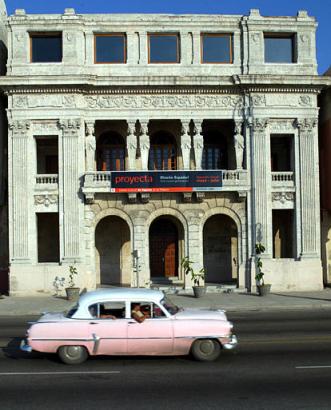 Ignore the platitudes for Fidel. "But everyone gets free heath care." Health care has to be free when everyone is a slave. Look at the facts.
The real story is that a prosperous Cuba was turned into ruins in just five decades.
Investors' Business Daily editorial
Its inflation-adjusted gross domestic product is a mere 5% of what it was in 1958, the year before Castro took over, according to Jorge Salazar-Carillo of Florida International University.
"It's a major failure," Carmelo Mesa-Lago, a University of Pittsburgh economist, told IBD. "Cuba is unable to increase food production to meet its needs and now imports 84% of its food. Cuba produced 7 million tons of sugar in 1952. This year, it's 1.5 million tons. This is the result of economic policy of collectivization, killing of individual incentive, inefficiency, constant changes of policy."
Reliable data are hard to come by. S&P refuses to rate the country for that reason. The regime conceals its failures. But if long lines at the Spanish embassy seeking immigration aren't enough of an indicator, the chronology of Cuba's economy tell an important story:
1957: Cuban GDP is about $2.8 billion, unadjusted for inflation.
1959: Castro and his guerrillas take over and begin confiscating U.S.-owned private businesses.
1960: President Eisenhower imposes trade embargo, excluding food and medicine; Castro responds by "rapidly nationalizing most U.S. enterprises," as he himself wrote.
1961: President Kennedy tightens the embargo. Castro blames it for plant shutdowns, parts shortages and 7,000 transportation breakdowns a month, leaving 25% of public buses inoperable. He then targets Cuban companies for expropriation.
1962: Begins food rationing. Half of passenger rail cars go out of service from lack of maintenance.
1963: President Kennedy freezes Cuban assets in the U.S.
1965: Signs deal with USSR to reschedule $500 million in debt.
1966: Signs new deal with Soviets for $91 million in trade credits.
1968: Begins petroleum rationing, says Soviets cut supplies.
1969: Begins sugar rationing in January, announces state plan to produce 10 million tons of sugar by the following year.
1970: Castro announces only 8.5 million tons of sugar produced. Blames U.S. Diverts 85% of all Cuban trade to the USSR.
1973: Tries for the first time to tie wages to productivity.
1974: Ramps up wartime spending to send 3,000 Cuban troops to Africa. It hits $125 per person, highest in Latin America, by 1988.
1975: President Ford announces softening of the embargo, letting foreign subsidiaries of U.S. companies sell products in Cuba.
1979: President Carter lets Cuban-Americans visit family in Cuba. Soviet aid totals $17 billion from 1961-79, or 30% of Cuba's GDP.
1980: Economic hardship forces Castro to permit farmers to sell surplus to state quotas in private markets with unregulated prices. 100,000 Cubans flee the island for the U.S. via the Mariel boatlift.
1982: Cuba doubles military spending. President Reagan re-establishes travel ban and prohibits spending money on the island.
1983: Cuba signs accord in Paris to refinance its foreign debt.
1984: "Armed Forces of Latin America" yearbook says: "Cuba is probably the world's most completely militarized country."
1985: Cuba signs new debt restructuring, blaming Mexico's crisis for its debacle. Permits selling of private housing for the first time. Total aid from USSR since 1961 hits $40 billion.
1986: Castro defaults on $10.9 billion in Paris Club debt. Blames sugar prices. Abolishes coffee breaks, cuts subsidies. Soviets give $3 billion more in credit and aid. Castro bans farmers markets.
1987: Stops paying entirely on $10.9 billion Paris Club debts.
1988: Forbids release of inflation data, making it impossible for researchers to assess Cuban economic performance.
1990: By official statistics, GDP per capita declines 10.3%.
1991: Sugar crop falls to 7 million tons. Politburo purged. USSR ends $5 billion in subsidies. "Special Period" of austerity begins.
1992: Horse-drawn carts replace cars, oxen replace Soviet tractors. Time magazine reports tin cans are recycled into drinking cups and banana peels into Cuban sandals.
1993: World Bank says GDP contracts 15.1% per capita, as industrial output plunges 40% per person.
1994: Some private-sector activity permitted. GDP per capita shows no growth, but Castro hails "recovery." Agricultural output down 54% from 1989, with sugar at 4 million tons. Castro blames bad finances, and "errors and inefficiency." Food consumption, according to USDA, falls 36%. Some 32,000 Cubans flee for Florida.
1995: Havana admits GDP fell 35% from 1989 to 1993. Vice President Carlos Lage claims GDP grew 2.5%, as inflation hits 19%.
1996: Castro hikes private business taxes. President Clinton tightens embargo. Castro claims GDP rose to 7% in year.
1997: GDP reported up 2.5%, falling short of 5% projection. Failed sugar harvest, bad weather, crop pests, foreign debts blamed.
1998: GDP growth claimed at 1.2% with no inflation. U.S. embargo, global financial crisis, low commodity prices, too much rainfall, Hurricane Georges and severe drought blamed. Castro urges other debtor nations to form a cartel.
1999: GDP claimed at 6.2%. Subsidies from Venezuela begin. Castro blames U.S. dollar for woes and urges use of the euro.
2000: Cuban court rules U.S. owes Cuba $121 billion for embargo.
2001: 3.6% GDP growth, output remains below 1989. Blames loss of subsidies, second-worst sugar harvest ever at 3.5 million tons.
2002: Freezes dollar sales to preserve foreign reserves. Shuts down 118 factories due to power shortages. Buys $125 million in U.S. food. Defaults on $750 million in Japanese debts.
2003: Earns more tight sanctions from President Bush and European Union over dissident roundups. GDP rises just 1.8%.
2004: Castro declares GDP a capitalist instrument, adjusts calculations, declares GDP growing at 5%.
2005: Foreign firms asked to leave and market liberalization scrapped. Imports hit three-times the level of exports. Hurricanes blamed for falling farm output. Sugar figures not released. Castro calls economic crisis an "enemy fabrication." Claims GDP up 11%.
2006: Castro claims 12.5% economic growth, "despite the crippling effects of the U.S. embargo," Luxner News notes.
2007: 7.5% GDP growth claimed; adverse weather said to have affected construction and agriculture.
2008: 4.3% GDP growth claimed, far short of 8% forecast. "One of the most difficult years since the collapse of the Soviet Union," economy minister says. Hurricanes and fuel prices blamed.
That, in sum, is Cuba after 50 years. But lest you get the wrong idea, Cuba hasn't failed at everything: "Given [Castro's] goal — to destroy capitalism and entrench themselves — they're a success," said Humberto Fontova, an expert on Castro's regime.
Ignore the platitudes for Fidel. "But everyone gets free heath care." Health care has to be free when everyone is a slave. Look at the facts.
The real story is that a prosperous Cuba was turned into ruins in just five decades.
Investors' Business Daily editorial
Its inflation-adjusted gross domestic product is a mere 5% of what it was in 1958, the year before Castro took over, according to Jorge Salazar-Carillo of Florida International University.
"It's a major failure," Carmelo Mesa-Lago, a University of Pittsburgh economist, told IBD. "Cuba is unable to increase food production to meet its needs and now imports 84% of its food. Cuba produced 7 million tons of sugar in 1952. This year, it's 1.5 million tons. This is the result of economic policy of collectivization, killing of individual incentive, inefficiency, constant changes of policy."
Reliable data are hard to come by. S&P refuses to rate the country for that reason. The regime conceals its failures. But if long lines at the Spanish embassy seeking immigration aren't enough of an indicator, the chronology of Cuba's economy tell an important story:
1957: Cuban GDP is about $2.8 billion, unadjusted for inflation.
1959: Castro and his guerrillas take over and begin confiscating U.S.-owned private businesses.
1960: President Eisenhower imposes trade embargo, excluding food and medicine; Castro responds by "rapidly nationalizing most U.S. enterprises," as he himself wrote.
1961: President Kennedy tightens the embargo. Castro blames it for plant shutdowns, parts shortages and 7,000 transportation breakdowns a month, leaving 25% of public buses inoperable. He then targets Cuban companies for expropriation.
1962: Begins food rationing. Half of passenger rail cars go out of service from lack of maintenance.
1963: President Kennedy freezes Cuban assets in the U.S.
1965: Signs deal with USSR to reschedule $500 million in debt.
1966: Signs new deal with Soviets for $91 million in trade credits.
1968: Begins petroleum rationing, says Soviets cut supplies.
1969: Begins sugar rationing in January, announces state plan to produce 10 million tons of sugar by the following year.
1970: Castro announces only 8.5 million tons of sugar produced. Blames U.S. Diverts 85% of all Cuban trade to the USSR.
1973: Tries for the first time to tie wages to productivity.
1974: Ramps up wartime spending to send 3,000 Cuban troops to Africa. It hits $125 per person, highest in Latin America, by 1988.
1975: President Ford announces softening of the embargo, letting foreign subsidiaries of U.S. companies sell products in Cuba.
1979: President Carter lets Cuban-Americans visit family in Cuba. Soviet aid totals $17 billion from 1961-79, or 30% of Cuba's GDP.
1980: Economic hardship forces Castro to permit farmers to sell surplus to state quotas in private markets with unregulated prices. 100,000 Cubans flee the island for the U.S. via the Mariel boatlift.
1982: Cuba doubles military spending. President Reagan re-establishes travel ban and prohibits spending money on the island.
1983: Cuba signs accord in Paris to refinance its foreign debt.
1984: "Armed Forces of Latin America" yearbook says: "Cuba is probably the world's most completely militarized country."
1985: Cuba signs new debt restructuring, blaming Mexico's crisis for its debacle. Permits selling of private housing for the first time. Total aid from USSR since 1961 hits $40 billion.
1986: Castro defaults on $10.9 billion in Paris Club debt. Blames sugar prices. Abolishes coffee breaks, cuts subsidies. Soviets give $3 billion more in credit and aid. Castro bans farmers markets.
1987: Stops paying entirely on $10.9 billion Paris Club debts.
1988: Forbids release of inflation data, making it impossible for researchers to assess Cuban economic performance.
1990: By official statistics, GDP per capita declines 10.3%.
1991: Sugar crop falls to 7 million tons. Politburo purged. USSR ends $5 billion in subsidies. "Special Period" of austerity begins.
1992: Horse-drawn carts replace cars, oxen replace Soviet tractors. Time magazine reports tin cans are recycled into drinking cups and banana peels into Cuban sandals.
1993: World Bank says GDP contracts 15.1% per capita, as industrial output plunges 40% per person.
1994: Some private-sector activity permitted. GDP per capita shows no growth, but Castro hails "recovery." Agricultural output down 54% from 1989, with sugar at 4 million tons. Castro blames bad finances, and "errors and inefficiency." Food consumption, according to USDA, falls 36%. Some 32,000 Cubans flee for Florida.
1995: Havana admits GDP fell 35% from 1989 to 1993. Vice President Carlos Lage claims GDP grew 2.5%, as inflation hits 19%.
1996: Castro hikes private business taxes. President Clinton tightens embargo. Castro claims GDP rose to 7% in year.
1997: GDP reported up 2.5%, falling short of 5% projection. Failed sugar harvest, bad weather, crop pests, foreign debts blamed.
1998: GDP growth claimed at 1.2% with no inflation. U.S. embargo, global financial crisis, low commodity prices, too much rainfall, Hurricane Georges and severe drought blamed. Castro urges other debtor nations to form a cartel.
1999: GDP claimed at 6.2%. Subsidies from Venezuela begin. Castro blames U.S. dollar for woes and urges use of the euro.
2000: Cuban court rules U.S. owes Cuba $121 billion for embargo.
2001: 3.6% GDP growth, output remains below 1989. Blames loss of subsidies, second-worst sugar harvest ever at 3.5 million tons.
2002: Freezes dollar sales to preserve foreign reserves. Shuts down 118 factories due to power shortages. Buys $125 million in U.S. food. Defaults on $750 million in Japanese debts.
2003: Earns more tight sanctions from President Bush and European Union over dissident roundups. GDP rises just 1.8%.
2004: Castro declares GDP a capitalist instrument, adjusts calculations, declares GDP growing at 5%.
2005: Foreign firms asked to leave and market liberalization scrapped. Imports hit three-times the level of exports. Hurricanes blamed for falling farm output. Sugar figures not released. Castro calls economic crisis an "enemy fabrication." Claims GDP up 11%.
2006: Castro claims 12.5% economic growth, "despite the crippling effects of the U.S. embargo," Luxner News notes.
2007: 7.5% GDP growth claimed; adverse weather said to have affected construction and agriculture.
2008: 4.3% GDP growth claimed, far short of 8% forecast. "One of the most difficult years since the collapse of the Soviet Union," economy minister says. Hurricanes and fuel prices blamed.
That, in sum, is Cuba after 50 years. But lest you get the wrong idea, Cuba hasn't failed at everything: "Given [Castro's] goal — to destroy capitalism and entrench themselves — they're a success," said Humberto Fontova, an expert on Castro's regime.
Friday, January 02, 2009
An atheist who believes Africa needs God
This atheist admits what he sees: that Christian missionaries make a big difference. Not just the physical things accomplished, but the changed lives.
Matthew Parris - Times Online :
Now a confirmed atheist, I've become convinced of the enormous contribution that Christian evangelism makes in Africa: sharply distinct from the work of secular NGOs, government projects and international aid efforts. These alone will not do. Education and training alone will not do. In Africa Christianity changes people's hearts. It brings a spiritual transformation. The rebirth is real. The change is good. I used to avoid this truth by applauding - as you can - the practical work of mission churches in Africa. It's a pity, I would say, that salvation is part of the package, but Christians black and white, working in Africa, do heal the sick, do teach people to read and write; and only the severest kind of secularist could see a mission hospital or school and say the world would be better without it. I would allow that if faith was needed to motivate missionaries to help, then, fine: but what counted was the help, not the faith. But this doesn't fit the facts. Faith does more than support the missionary; it is also transferred to his flock. This is the effect that matters so immensely, and which I cannot help observing. First, then, the observation. We had friends who were missionaries, and as a child I stayed often with them; I also stayed, alone with my little brother, in a traditional rural African village. In the city we had working for us Africans who had converted and were strong believers. The Christians were always different. Far from having cowed or confined its converts, their faith appeared to have liberated and relaxed them. There was a liveliness, a curiosity, an engagement with the world - a directness in their dealings with others - that seemed to be missing in traditional African life. They stood tall. ... Christianity, post-Reformation and post-Luther, with its teaching of a direct, personal, two-way link between the individual and God, unmediated by the collective, and unsubordinate to any other human being, smashes straight through the philosphical/spiritual framework I've just described. It offers something to hold on to to those anxious to cast off a crushing tribal groupthink. That is why and how it liberates. Those who want Africa to walk tall amid 21st-century global competition must not kid themselves that providing the material means or even the knowhow that accompanies what we call development will make the change. A whole belief system must first be supplanted. And I'm afraid it has to be supplanted by another. Removing Christian evangelism from the African equation may leave the continent at the mercy of a malign fusion of Nike, the witch doctor, the mobile phone and the machete.Read the whole thing.
Twas the night before in Seattle
"Twas the week before Christmas, and next to the Sound,
Not a creature was stirring, for all were snowbound.
Greyhound busses quit running, no matter the fare,
And the mail men and garbage said they just couldn't get there!
The children were sliding Queen Anne Hill on their sleds.
While roofs were collapsing on old people's heads.
And mamma in her boots and I in my cap,
Were stuck in the snow and ice and such crap.
When at the Home Depot there arose such a clatter,
I trudged from my car to see what was the matter.
A group of sad souls were waving their cash,
They couldn't buy shovels, they'd sold in a flash.
Tires were spinning and just wouldn't go,
And chains lay broken in the dirty old snow.
Then, what to my surprise did my eyes look over and see?
Eight representatives of SDOT,
With a fat politician so lively and quick,
I knew in a moment it was Mayor "Salt Nick".
More rapid than gun bans, his excuses they came,
"To save our environment the roads stay the same!
On Broadway! On Boren! On Yesler and Denny!,
To clear off these roads would cost such a penny!
Sliding down Thomas and onto a wall!
The busses hung over I-5, ready to fall!
Still, he insisted it wasn't his fault,
As the world's greenest mayor he wouldn't use SALT!
That stuff's corrosive, could hurt the fish.
(But the Puget Sound's SALT WATER you ignorant kish !)
So snowy Seattle continued to stew,
But Mayor "Salt Nick" just hadn't a clue. [Mayor Greg Nickels]
While I stood there astonished, on nearby TV sets,
I saw the airport was packed, no de-icer for jets.
Since others couldn't get down the roads to the ferry,
The city decided to close Denny and Cherry.
Police cars and firetrucks were highly impaired,
Citizens got no impression that Mayor Salt Nick cared.
A house that caught fire, or a rape in progress,
Was less important than "going green" in Seattle - I guess!
An accident closed the I-90 bridge,
And people couldn't drive down Phinney Ridge.
Shovels, and salt had just flown off the shelf,
And I laughed when I heard him in spite of myself.
A wink of his eye and a twist of his head,
He tried to convey we had nothing to dread;
He spoke many words, but did little work,
Yet Seattle knew they should never have elected this jerk.
Then thumbing his nose at his citizens' plight,
He turned to the crowd and exclaimed "We've done right!",
And then to his limo refusing to yield,
He left to get solar panels installed on Qwest Field.
But I heard him exclaim, as he skidded past me
"Happy Christmas to all, heck, I give myself a 'B' ".
from my friend Lisa.
Thursday, January 01, 2009
Depression? We have no idea
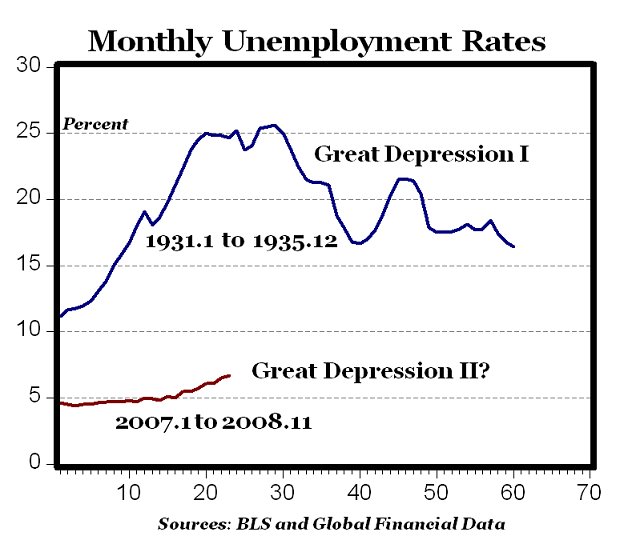 During the Great Depression of 1929 to 1940 there was no waiting line at Outback Steakhouse, which we saw last week. Everyone was hungry!
What about now?
Current unemployment has climbed from under 5 per cent to 7 per cent. During the real depression it was over 15 per cent for over 4 years; spend years above 20 per cent and reached 25 per cent. It didn't get below 15 per cent until World War II. FDR's takeover of the economy didn't end it, but prolonged it!
Via Carpe Diem, the blog of Prof M. J. Perry
Canada's health care monopoly: A Short Course in Brain Surgery
Many people want the dream of taking all health-care decisions away from individuals and leaving them to the "single payer" government. And no one is uninsured. But look at Canada. That benefit comes at the high cost of denied care. The high-tech, higher-cost procedures are burdened by long waiting times and DENIAL. When the caring bureaucrats says "No," it doesn't mean the system won;t pay for it, but You Can't Have the Surgery. Just plain NO.
Canadians have a safety outlet - the US border. Every day Canadians drive or fly into the US and pay for their own care - that Canada denied. The key factor is often time. In many cases the bureaucrats will eventually approve, then the wait of weeks or months for the surgeon and facility to be available. If the patient survives, she gets the care. But many don't survive.
On The Fence Films :: A Short Course in Brain Surgery:
In A Short Course in Brain Surgery, filmmaker Stuart Browning shows the callousness of "single-payer", government-run health care systems as practiced in Ontario, Canada. His film highlights the plight of Lindsay McCreith, an Ontario man with a cancerous brain tumor who went to Buffalo, NY to receive the timely medical care that is rationed in his home country.It's only a few minutes. Watch it.
Chicago Politics: From Scandal to Surrealism to Burris
Too strange. Blago's pick for US Senate: Roland Burris.
Radio host David Boze at MyNorthwest.com:
Roland Burris, Blago's pick for United States Senator, has built a monument to himself...literally. The mausoleum he built for himself in Oak Woods Cemetery on Chicago's South Side includes a bold text "TRAIL BLAZER" and a list of "MAJOR ACCOMPLISHMENTS" just in case anyone walking through the graveyard wants to see what a powerful man he was...or is since he's still alive. AWESOME WEIRD
Tuesday, December 30, 2008
Thomas Paine and crisis during the Revolution
After the Continental Army was driven out of New Jersey, an article titled "The American Crisis" was published in the Pennsylvania Journal, DECEMBER 23, 1776.
Written by an aide-de-camp to General Nathanael Greene named Thomas Paine, General Washington ordered it read to the troops:
"These are the times that try men's souls. The summer soldier and the sunshine patriot will, in this crisis, shrink from the service of his country... Tyranny, like hell, is not easily conquered; yet we have this consolation with us that the harder the conflict, the more glorious the triumph."
Thomas Paine continued:
"What we obtain too cheap, we esteem too lightly....Heaven knows how to put a price upon its goods; and it would be strange indeed if so celestial an article as freedom should not be highly rated... God Almighty will not give up a people to military destruction...who have so earnestly...sought to avoid the calamities of war."
Paine concluded:
"The whole English army, after ravaging the kingdom of France, was driven back...by a few broken forces headed by a woman, Joan of Arc. Would that heaven might inspire some Jersey maid to spirit up her countrymen... 'Show your faith by your works,' that God may bless you...I thank God, that I fear not."
Via: American Minute
I learned of the importance of Tom Paine while reading Washington's Crossing. Author: David Hackett Fischer. Excellent account of amazing true history.
Monday, December 29, 2008
Collision - The merger of Delta and Northwest airlines
 How will they become one airline when they can't work together as two?
Local News | Planes bump on ground at Sea-Tac | Seattle Times Newspaper:
How will they become one airline when they can't work together as two?
Local News | Planes bump on ground at Sea-Tac | Seattle Times Newspaper:
Two flights bound for the Midwest from Seattle were canceled this morning when the passenger-filled planes backed into each other as they left their gates, airport officials said. No one was injured. A Delta 737-800 plane, Flight 1288 to Cincinnati, was backing away from its gate at the Concourse Terminal at Seattle-Tacoma International Airport, shortly before 7 a.m, according to airport spokeswoman Terri-Ann Betancourt. At the same time, Betancourt said, a Northwest 757-300 plane, Flight 620 to Minneapolis, was backing away from its gate at the South Satellite Terminal.
Sunday, December 28, 2008
Say goodnight, Caroline: How JFK's daughter flubbed the audition to become the next Senator Kennedy
Interesting observation on Caroline Schlossberg's campaign to carry on Camlot.
NY Daily News quoting:
... But a strange thing is happening on the way to the coronation. The wheels of the bandwagon are coming off. Fantasy is giving way to inescapable truth. * That truth is that Kennedy is not ready for the job and doesn't deserve it. Somebody who loves her should tell her.
Her quest is becoming a cringe-inducing experience, as painful to watch as it must be to endure. Because she is the only survivor of that dreamy time nearly 50 years ago, she remains an iconic figure. But in the last few days, her mini-campaign has proved she has little to offer New Yorkers except her name.
Her handlers and family enablers insist she feels no entitlement to the Senate job, yet there is no other possible reason to give it to her. Her name is the sole reason she even dares go for it. Camelot must be Gaelic for chutzpah.
... Kennedy apparently decided to go public to build support and scare off others, including Attorney General Andrew Cuomo, whose nasty divorce from her cousin still roils both clans. Kennedy also had to introduce herself to Democratic party leaders because, other than endorsing Obama, her politics were a mystery.
But the minute she faced the routine questions that help define a candidate for virtually any office, she had nothing to say. There was no "there" there.
"I just hope everybody understands that it is not a campaign but that I have a lifelong devotion to public service," she said during her first-ever visit to Rochester. "I've written books on the Constitution and the importance of individual participation. And I've raised my family. I think I really could help bring change to Washington."
... "I'm really coming into this as somebody who isn't, you know, part of the system, who obviously, you know, stands for the values of, you know, the Democratic Party. I know how important it is to, you know, to be my own person. And, you know, and that would be obviously true with my relationship with the mayor.
Saturday, December 27, 2008
Scientific illiteracy epidemic among the glitterati
When it comes to science, Barack Obama is no better than many of us. Today he joins the list of shame of those in public life who made scientifically unsupportable statements in 2008.
Science, News - The Independent: quoting:
When it comes to science, Barack Obama is no better than many of us. Today he joins the list of shame of those in public life who made scientifically unsupportable statements in 2008.
Closer to home, Nigella Lawson and Delia Smith faltered on the science of food, while Kate Moss, Oprah Winfrey and Demi Moore all get roastings for scientific illiteracy.
The Celebrities and Science Review 2008, prepared by the group Sense About Science, identifies some of the worst examples of scientific illiteracy among those who profess to know better – including top politicians.
Mr Obama and John McCain blundered into the MMR vaccine row during their presidential campaigns. "We've seen just a skyrocketing autism rate," said President-elect Obama. "Some people are suspicious that it's connected to the vaccines. This person included. The science right now is inconclusive, but we have to research it," he said.
His words were echoed by Mr McCain. "It's indisputable that [autism] is on the rise among children, the question is what's causing it," he said. "There's strong evidence that indicates it's got to do with a preservative in the vaccines."
Thursday, December 25, 2008
Bettors Beat Pundits
The collective wisdom of people who risked their own money beat every pundit on the presidential election. From one of my favorite science journalists - John Tierney at NY Times.
Bettors Beat Pundits - TierneyLab Blog - NYTimes.com:
We debated the merits of collective wisdom earlier this year, after the bettors in the the Intrade online prediction market wrongly picked Barack Obama to win the New Hampshire primary. The bettors are looking more savvy now that the election’s over and the last undecided state, Missouri, has finally been called for John McCain. Once again, collective wisdom backed by cash has triumphed over conventional wisdom — at least when you compare the Intrade bettors with some of the pundits who get paid to make predictions. On the morning of Election Day, I printed out the expectations from the Dublin-based Intrade market as well as a roundup of predictions from nearly two dozen political consultants, journalists and academics that appeared at the Huffington Post. The Intrade bettors expected Mr. Obama to end up with 364 votes in the Electoral College — one less than he actually got. None of the pundits came so close. Alan Abramowitz, a political scientist at Emory, came closest with prediction of 361; all the rest were off by at least 12 votes. Nate Silver, the much-talked-about statistician at FiveThirtyEight.com, underestimated Mr. Obama’s tally by 18 votes. Many of the pundits underestimated Mr. Obama’s total by more than 25 votes, like Chris Matthews, Arianna Huffington, and the strategists Paul Begala, James Carville and Alex Castellanos.

Wednesday, December 24, 2008
Back home: Seattle refuses to use salt; roads "snow packed" by design
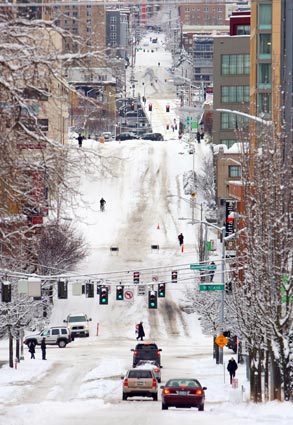 We got out of Los Cabos only an hour late. We had to pay big bucks for a taxi because Shuttle Express isn't doing home delivery. They wouldn't have trouble at our home a mile north of the Seattle city limites, but I don't blame them.
And ... Seattle is leaving the streets frozen on purpose... The street department is not using salt... to save the fish!?
Seattle Times Newspaper:
[In Seattle] there's snow and ice left on major arterials by design.
"We're trying to create a hard-packed surface," said Alex Wiggins, chief of staff for the Seattle Department of Transportation. "It doesn't look like anything you'd find in Chicago or New York."
The city's approach means crews clear the roads enough for all-wheel and four-wheel-drive vehicles, or those with front-wheel drive cars as long as they are using chains, Wiggins said.
The icy streets are the result of Seattle's refusal to use salt, an effective ice-buster used by the state Department of Transportation and cities accustomed to dealing with heavy winter snows.
"If we were using salt, you'd see patches of bare road because salt is very effective," Wiggins said. "We decided not to utilize salt because it's not a healthy addition to Puget Sound."
We got out of Los Cabos only an hour late. We had to pay big bucks for a taxi because Shuttle Express isn't doing home delivery. They wouldn't have trouble at our home a mile north of the Seattle city limites, but I don't blame them.
And ... Seattle is leaving the streets frozen on purpose... The street department is not using salt... to save the fish!?
Seattle Times Newspaper:
[In Seattle] there's snow and ice left on major arterials by design.
"We're trying to create a hard-packed surface," said Alex Wiggins, chief of staff for the Seattle Department of Transportation. "It doesn't look like anything you'd find in Chicago or New York."
The city's approach means crews clear the roads enough for all-wheel and four-wheel-drive vehicles, or those with front-wheel drive cars as long as they are using chains, Wiggins said.
The icy streets are the result of Seattle's refusal to use salt, an effective ice-buster used by the state Department of Transportation and cities accustomed to dealing with heavy winter snows.
"If we were using salt, you'd see patches of bare road because salt is very effective," Wiggins said. "We decided not to utilize salt because it's not a healthy addition to Puget Sound."
Monday, December 22, 2008
Stuck in Cabo - Almost
We just might be stuck in Cabo San Lucas, Mexico. You won't feel sorry for us if you take a look at Playa Grande Resort (means big beach). It's in a great location on the Pacific Ocean side of Land's End, but still walking distance to the marina and its shops, even for us lame people. Though we moved to a cheaper hotel for our last two days. Alaska Airline ceased all operations at the Seattle airport Sunday night. Of about 30 flights scheduled to arrive only 3 long hauls from Hawaii and Mexico arrived between 6 pm and midnight. See FlightStats.com by airline and airport. But they only go back one day, as far as I can find. Our flight is Tuesday at 4:30. Wish us luck - to be stuck here. No! To get home for Christmas. But, most of all, not to be stuck at LAX.
Update 12/24: Our flight went and only one hour late. It was canceled Sunday, so some people "had to" stay longer and others took their chances at LAX. I have been following the industry for over 30 years and here is what I would do if I were in their place. I would not go to the airport until I knew my flight was going.
- Go to FlightStats.com. First, look at your flight - its status. The problem is that airlines often don't want to tell the bad news. But they are better about it now, particularly because they get a worse mark on their record for a very late flight than for canceling. So check your flight for its expected departure status.
- An additional help: If the airline won't tell you, then look for clues! In some cases you can guess which flight the aircraft will do before your flight. Then you check for the departure of that previous flight at the airline's web site or FlightStats. For example, at Los Cabos the flight to Seattle is preceded by the flight from Seattle. (The problem with this method is you almost always need to be leaving for the airport by that departure time, so step 3.)
- Set alerts at FlightStats.com. FlightStats will send you email or call your cell phone when the status of the flight you choose changes. So you can get the update while you are on the road.
- But - don't go to the airport if there is reasonable doubt your flight will go. Stay in the sun by the pool or on the beach! And go online to change your flight or call the airline.
The photo [has been removed]: Land's End - the end of Baja California - at Cabo San Lucas. Sand under the arch, as pictured here, occurs only once every few years and only when both the Moon is closer to the Earth than usual and it is full or new moon. This occurred last week.
Friday, December 19, 2008
Bush is not a unilateralist
Charges that President Bush only acts "go it alone" fall flat against evidence he has had many major foreign efforts that have been carried out in cooperation with the beneficiaries and with other aiding countries.
Paul Dobrianski has been involved in many of these efforts as Undersecretary for democracy and global affairs. "Every issue here has a vibrant multilateral component to it.
But who has noticed? One problem has been that the efforts are not in the hard-policy head-line areas, but in soft, long-term efforts that go on quietly, without much notice.
For example, they began efforts to aid Afghan women to start small businesses early on they met with two young women who were starting a micro-finance bank - only two. Their next meeting they had to meet in the cafeteria at the US Embassy because 80 to 100 women attended. The next meeting was at the offices of the women financiers. A little targeted assitance had a large effect.
Trafficking of persons = Early in his administration Bush created an office to focus on this problem - the first in the world. Today dozens of countries have such offices.
Congo Basin - In 2002 the US announced a major effort to protect the world's second largest rain forest. With 40 governments and other groups.
Avian Flu - In 2005 Bush started international partnerships to combat this flu.
Democracy - With US leadership the UN created the Democracy Fund to aid projects to further democracy.
Africa - Bush increased health funding by 4 times. And his effort for HIV/AIDS in Africa dwarfs what Clinton did. We have friends who are working actively in Uganda who say that Bush has been very good for Africa.
Source: "Bush was no unilateralist," Wall Street Journal, December 13-14, 2008.
Murtha still calls our Marines cold-blooded killers
When Congressman Jack Murtha was accusing our Marines of being cold-blooded killers, several of them were charged and going to be tried. Acquittal on the charges isn't enough for pork-spending Jack. He says they are guilty after they have been found innocent.
CNS News
Although all of the charges have been dropped against all of the Marines – except for one – involved in the killing of Iraqi civilians in Haditha in 2005, Rep. John Murtha (D-Pa.) said he stands by his May 2006 remarks that the Marines involved “killed innocent civilians in cold blood.”
Thursday, December 11, 2008
Stunning Snowflake Photographs
 This is great.
Snowflake and Snow Crystal Photographs:
These pictures show real snow crystals that fell to earth in Northern Ontario, Alaska, Vermont, the Michigan Upper Peninsula, and the Sierra Nevada mountains of California. They were captured by Kenneth G. Libbrecht using a specially designed snowflake photomicroscope.
This is great.
Snowflake and Snow Crystal Photographs:
These pictures show real snow crystals that fell to earth in Northern Ontario, Alaska, Vermont, the Michigan Upper Peninsula, and the Sierra Nevada mountains of California. They were captured by Kenneth G. Libbrecht using a specially designed snowflake photomicroscope.
He has a book we saw in the bookstore. The variety is incredible.
Tuesday, December 09, 2008
Obama will pay for "green" buildings - WASTE
My response to Marginal Revolution
Green buildings
Seattle built a new "green" city hall a few years back and got a gold LEED certificate for it. Here is the press release.
But... now the reality. The new building is WORSE than the old one. Seattle P-I
"Seattle's new City Hall is an energy hog - Higher utility bills take the glow off its 'green' designation "Seattle's new City Hall was designed with the environment in mind, using the most energy-efficient technologies. "But the building acts like an old-fashioned electricity hog. It has lofty public spaces and walls of glass designed to welcome citizens and suggest an open and transparent government. It also uses 15 percent to 50 percent more electricity some months than the older, larger building it replaced, according to Seattle City Light utility bills. "The high energy use is an embarrassment for the city at a time when Mayor Greg Nickels is urging municipalities across the country to cut their energy consumption and voluntarily comply with the Kyoto environmental protocols. City Council member
On the Street, Disbelief and Resignation - WSJ.com
WSJ.com:
Inside what's left of Wall Street, investment bankers are doing all they can to cope with a business that is disappearing before their eyes. Yes, there are tens of thousands of people still with jobs. They just don't have much work. Debt and stock markets are virtually shut, merger volume is down by 28%, and whole lines of structured finance are closed for good.
Investment banking has since become a phantom realm, where everyone is busy but no one is doing anything. In this world, status is conferred by a quality meeting, not a completed transaction; a $700,000 salary is deemed generous; and an apocryphal story keeps circulating of a former J.P. Morgan Chase & Co. mortgage-securities banker now driving a forklift.
"An entire generation has worked for 20 years, lifted up their heads, and it's all gone 'poof,' " says one Goldman Sachs banker. Indeed, last Friday J.P. Morgan quietly laid off a passel of Bear Stearns bankers. They thought they had found a safe harbor after Bear imploded early this year.
For now, the coping is taking the form of prolific meeting-taking. Ten of 11 people interviewed described, with unexpected eagerness, how now is a good time to "connect with clients" or "build relationships." One boasted of spending just two days a month in the office, while another ex-J.P. Morgan employee boasted of two breakthrough meetings -- just hours before he was fired.
Sunday, December 07, 2008
Single-payer healthcare is cheaper, but for less and poorer quality care
 I intend to follow the effort to get control of our health-care system - government control. Can Tom Daschle put together a system that has the efficiency of the US Postal Service with the compassion of the IRS? Does he intend to? No. But he is likely to "succeed."
During Clinton's term while Hillary's complete takeover failed they did get hold of the system of vaccines for kids. And it was a mess. Slower and more expensive than the various parts and pieces that together worked before.
The following is by Brett Skinner of the Fraser Institute in Canada. They do excellent work in several areas, including health care.
The Trouble with Canadian Healthcare - The American, A Magazine of Ideas
I intend to follow the effort to get control of our health-care system - government control. Can Tom Daschle put together a system that has the efficiency of the US Postal Service with the compassion of the IRS? Does he intend to? No. But he is likely to "succeed."
During Clinton's term while Hillary's complete takeover failed they did get hold of the system of vaccines for kids. And it was a mess. Slower and more expensive than the various parts and pieces that together worked before.
The following is by Brett Skinner of the Fraser Institute in Canada. They do excellent work in several areas, including health care.
The Trouble with Canadian Healthcare - The American, A Magazine of Ideas
... the alleged superiority of single-payer health care is not consistent with the evidence. The reality is that, on average, Americans spend more of their income on healthcare than Canadians do but get faster access to more and better medical resources. Healthcare appears to cost less in Canada than in the United States partly because Canadian government health insurance does not cover many advanced medical treatments and technologies that are commonly available to Americans.
If Canadians had access to the same quality and quantity of healthcare resources that Americans enjoy, Canada’s government health insurance monopoly would cost much more than it currently does.
Our recent study comparing healthcare in the United States and Canada shows that the public-private U.S. system outperforms the Canadian system on almost all the key indicators of available healthcare resources. The United States even performs nearly as well as Canada in terms of providing “effective” health insurance coverage for its population.
Americans spend 55 percent more than Canadians do on healthcare as a percentage of their national economy. But consider what Americans get for the money they spend: compared to Canada, the United States has 327 percent more MRI units and 183 percent more CT scanners per million population. The United States also produces 100 percent more inpatient surgical procedures per million population, and it has 14 percent more physicians and 19 percent more nurses per million population. U.S. hospitals are newer and better equipped than Canadian hospitals, and Americans have access to more new medicines than Canadians.
Other important facts about single-payer health insurance in Canada that are seldom reported by the pundits or politicians include the following:
• In 1993, Canadian patients waited an average of 9.3 weeks between the time they saw their family physician and the time they actually received the treatment they needed. By 2007, the average wait time had almost doubled to 18.3 weeks. The median wait time in Canada is nearly double the wait time that physicians consider clinically reasonable.
• The Canadian single-payer system does not cover prescription drugs on a universal basis. Only about one-third of the Canadian population is eligible for various government-financed drug programs. The remainder of the population has private sector drug insurance coverage or pays cash for outpatient drugs, just like in the United States.
• Public drug plans in Canada often refuse to cover new drugs. On average, only 44 percent of all new drugs that were approved as safe and effective by the Canadian government in 2004 were actually covered by government drug insurance programs in October 2007. Even for the small percentage of new drugs that are covered by public drug programs, patients have to wait nearly one year, on average, after government approval for public insurance to start covering these new drugs.
• Consumers in Canada and the United States spend roughly the same proportion of their per-capita GDP on prescription drugs (1.5 percent in Canada compared to 1.7 percent in the United States). As a percentage of per-capita, after-tax income, the cost burden of prescription drug spending is slightly higher in Canada (2.5 percent in Canada compared to 2.3 percent in the United States).
• Between the fiscal years 1997-98 and 2006-07, government spending on healthcare grew in all 10 Canadian provinces at an average annual rate of 7.3 percent, while total available provincial revenue grew at an average annual rate of 5.9 percent and provincial GDP grew at an average annual rate of 5.6 percent. This level of government healthcare spending is unsustainable over the long haul.
Supporters of the Canadian healthcare system like to point out that the American system fails to provide universal health insurance coverage. This is true. But it’s also true that Canada doesn’t do much better when it comes to actually delivering access to necessary medical care. Government data show that an estimated 1.7 million Canadians—in a country of around 33-34 million—were unable to access a regular family physician in 2007. Without access to a family doctor, a person can’t obtain regular primary care or referrals for elective specialty medical services.
Moreover, that 1.7 million estimate does not include the many Canadians who have access to a regular family doctor but are on waiting lists for specialist treatment. Access to a waiting list is not the same thing as access to healthcare. When Canadians can’t get access to healthcare, they are no better off than uninsured Americans.
For that matter, how many Americans are really uninsured? We often hear that 47 million Americans lack health insurance. Yet research in the United States has demonstrated that the actual number of “effectively” uninsured Americans is less than half that number, and that being uninsured is usually only a temporary condition. Indeed, the estimated percentage of the population that was “effectively” uninsured for non-emergency, necessary medical services in 2007 was not that different in the United States and Canada: 7.9 percent in the United States compared to at least 6 percent in Canada.
Canadian patients who want to escape the delays in the public system are also barred from paying privately for healthcare services. In practical terms, Canadian patients are unable to buy quicker access or better care than the government health program provides. In this sense, Canadian patients on waiting lists are worse off than uninsured Americans, the latter of whom are at least legally allowed to use their own money or credit to buy healthcare.
Ironically, while Canadian-style healthcare appears to be gaining support in the United States, it is losing support and legitimacy in Canada. In a 2005 case challenging Quebec’s government-run health insurance program, the Supreme Court of Canada declared the single-payer system a violation of a person’s right to preserve his or her own health. Similar cases are now underway in two other Canadian provinces.
Ultimately, a single-payer system is probably the least effective way to achieve universal health insurance coverage. Canada has proved this in spades. The U.S. healthcare model may be flawed, but the Canadian model is far worse.
The graphic: I went from two crutches to one the first week of August and dropped the one around October 1. See broken pelvis.
Saturday, December 06, 2008
Prodigal Governors feed the hogs
Should we reward budget-busting irresponsibility? The states that were undisciplined and spent more than they took in want us to.
Prodigal Governors by The Editors on National Review Online:
The states have been on a spending jag, and now that the bills are coming due, Washington is hosting a parade of governors led by Arnold Schwarzenegger, who has demanded that the federal bursars “get off of their rigid ideologies” and write him a check for a couple dozen billion dollars. Tellingly, he compares the state of California to an “accident victim on the side of the road that is bleeding to death.” But this was no accident. Who was behind the wheel, governor?
California’s projected budget deficit over the next 20 months is about $28 billion, or 26 percent of the state’s budget. Since taking over from Gray Davis, who didn’t exactly set the gold standard of fiscal discipline, Schwarzenegger has steered the state into a 40-percent increase in spending, some $41 billion a year. Arithmetically inclined readers may calculate that California’s spending increase under Schwarzenegger and the usual spendthrift Democrats in the legislature is a greater sum than the projected shortfall. Which is to say, if only Californians could return to the Gray Davis version of fiscal discipline, they’d be in the black. But spending under Schwarzenegger has grown at twice the rate it did under Davis. If this is the alternative, give us that old-time rigid ideology, the one that says Republicans were put on this Earth with a mandate to cut spending and lower taxes.
Instead of looking to Washington for a handout, the prodigal governors should look to their more prudent brothers, such as Gov. Rick Perry of Texas. Noting on Tuesday that Texas currently enjoys a budget surplus, Governor Perry laid out his state’s formula for success: “Texas has created a business-friendly environment where 1,000 people a day move to our state to work and raise a family.” Montana’s Democratic governor, Brian Schweitzer, is no captive to conservative ideology, but he stewards a surplus as well, helped along by Republicans in the state senate.
Even in Alaska, where 90 percent of the state’s revenue depends in some part on oil, the price of which has this year fallen by two-thirds, Governor Palin is managing admirably. Raising Wyoming’s taxes to subsidize Californians’ extravagance violates both prudence and federalism; we have 50 different states for a reason.
Thursday, December 04, 2008
Calling All Pakistanis
Tom Friedman asks if the people of Pakistan strongly oppose the Mumbai mass killing.
Op-Ed Columnist - Tom Friedman - NYTimes.com:
...if 10 young Indians from a splinter wing of the Hindu nationalist Bharatiya Janata Party traveled by boat to Pakistan, shot up two hotels in Karachi and the central train station, killed at least 173 people, and then, for good measure, murdered the imam and his wife at a Saudi-financed mosque while they were cradling their 2-year-old son — purely because they were Sunni Muslims — where would we be today? The entire Muslim world would be aflame and in the streets.
So what can we expect from Pakistan and the wider Muslim world after Mumbai? India says its interrogation of the surviving terrorist indicates that all 10 men come from the Pakistani port of Karachi, and at least one, if not all 10, were Pakistani nationals.
First of all, it seems to me that the Pakistani government, which is extremely weak to begin with, has been taking this mass murder very seriously, and, for now, no official connection between the terrorists and elements of the Pakistani security services has been uncovered.
At the same time, any reading of the Pakistani English-language press reveals Pakistani voices expressing real anguish and horror over this incident. Take for instance the Inter Press Service news agency article of Nov. 29 from Karachi: “ ‘I feel a great fear that [the Mumbai violence] will adversely affect Pakistan and India relations,’ the prominent Karachi-based feminist poet and writer Attiya Dawood told I.P.S. ‘I can’t say whether Pakistan is involved or not, but whoever is involved, it is not the ordinary people of Pakistan, like myself, or my daughters. We are with our Indian brothers and sisters in their pain and sorrow.’ ”
But while the Pakistani government’s sober response is important, and the sincere expressions of outrage by individual Pakistanis are critical, I am still hoping for more. I am still hoping — just once — for that mass demonstration of “ordinary people” against the Mumbai bombers, not for my sake, not for India’s sake, but for Pakistan’s sake.
Why? Because it takes a village. The best defense against this kind of murderous violence is to limit the pool of recruits, and the only way to do that is for the home society to isolate, condemn and denounce publicly and repeatedly the murderers — and not amplify, ignore, glorify, justify or “explain” their activities.
... Why should Pakistanis do that? Because you can’t have a healthy society that tolerates in any way its own sons going into a modern city, anywhere, and just murdering everyone in sight — including some 40 other Muslims — in a suicide-murder operation, without even bothering to leave a note. Because the act was their note, and destroying just to destroy was their goal. If you do that with enemies abroad, you will do that with enemies at home and destroy your own society in the process
Wednesday, December 03, 2008
Honorable Jim McDermott dishonors his district
 Baghdad Jim McDermott is my own congressman. He is an underachiever: in 20 years there he has made some small successful initiatives for Africa, but nothing else.
Oh, he must have helped Hillary with her health-care initiative in 1995 that made people rush for the Republicans and stay with them for 12 years. He has always been in favor of big government.
Baghdad Jim McDermott is my own congressman. He is an underachiever: in 20 years there he has made some small successful initiatives for Africa, but nothing else.
Oh, he must have helped Hillary with her health-care initiative in 1995 that made people rush for the Republicans and stay with them for 12 years. He has always been in favor of big government.
He was trusted to provide an ornament for the White House Christmas tree. Too much responsibility for him. The request was for a "red, white and blue patriotic theme." He donated an ornament with his photo on it and a blurb about impeaching President Bush.
Tuesday, December 02, 2008
The Flying Man: Eric Liddell Olympic hero and martyr in China
Eric Liddell The Flying Man
Mission Frontiers:
In 1981, movie audiences in the USA and abroad were introduced to 1924 Olympic champion Eric Liddell through the film “Chariots of Fire,” which went on to win four Academy Awards, including the award for best picture. The focus of this film was on the events preceding and including those Olympic games in Paris....
What we are not told in that movie is that the second half of Eric Liddell’s life was every bit as inspiring as the first half – although in a different way. Now that inspiring story is to be portrayed in a major motion picture to be called “The Flying Man.”
The entire article is available in PDF form.
Thai Government Dissolved: Airports to Reopen?
Time vis Yahoo! News:
Thailand's already turbulent political landscape was thrown into further turmoil Tuesday when the Constitutional Court dissolved the ruling People Power Party (PPP) and two of its coalition partners for electoral fraud. As the verdict was read that the government leadership, including the current prime minister, would step down, anti-government protesters occupying Bangkok's two main airports erupted into cheers and waived Thai flags. Red-shirted government supporters, who had gathered outside the court building to try and prevent the proceedings, dismissed the decision as a judicial coup d'etat.At the Suvumbarmi (sp?) Bangkok airport someone fired a grenade that killed a PAD supporter and injured some others. Thailand is very dependent on tourism and the international airport is a major international hub. So closing it (and the domestic airport Don Muang) hurts a lot! PAD calls itself pro-democracy, but they oppose elections. They want the elite to pick the government.
Subscribe to:
Posts (Atom)
